Why Choose Anti-Static EPE Trays?
For electronic and precision components, packaging is not just about preventing impact. It is also important to prevent products from shifting, colliding with one another, rubbing against each other, or being affected by static electricity during handling.
Electronic components, PCBs, ICs, and precision parts can be damaged by impact, friction, or static electricity during handling, stacking, and shipping. While conventional foam provides cushioning, an improper fit may allow components to shift, and standard foam may not provide adequate ESD protection.
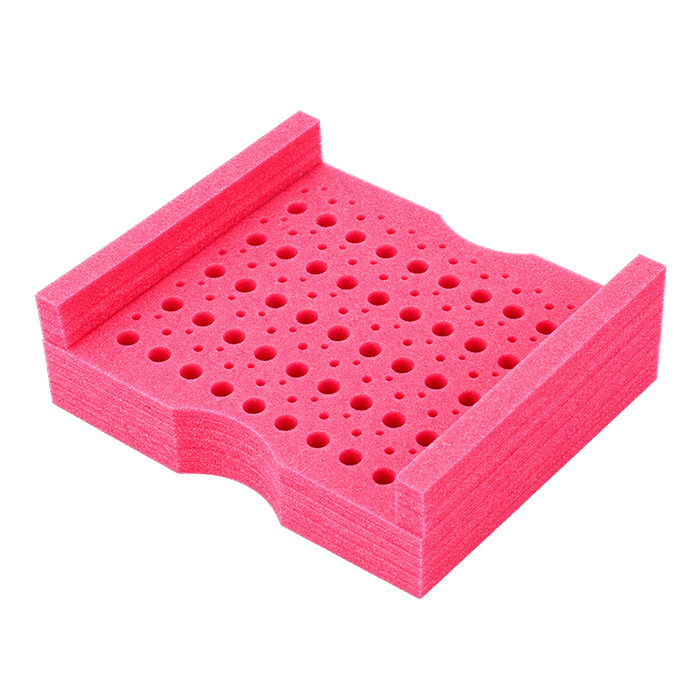
Anti-static EPE trays are made from anti-static EPE foam, offering lightweight construction, flexibility, resilience, and shock-absorbing properties. They can be customized with slots, cutouts, compartments, and layered structures according to component dimensions. Compared with loose-fill packaging materials, trays securely position each product in its designated location, making products easier to count, handle, and stack. They are suitable for factory processes, electronic component logistics, and export packaging.
Depending on specific requirements, options include standard white EPE, pink anti-static EPE, and other ESD-protective specifications. For ESD-sensitive components, the appropriate material should be selected based on actual surface resistance, testing standards, and application environment. Anti-static performance should not be determined solely by color.
FAQ
Q: What is the difference between anti-static EPE trays and standard EPE foam?
Standard EPE primarily provides shock absorption, cushioning, and scratch protection. Anti-static EPE additionally provides appropriate static protection for ESD-sensitive products. Actual performance should be evaluated based on material specifications and test results.
Q: Can EPE trays be reused?
Yes. If the material is not significantly damaged, contaminated, or deformed, it can be reused depending on the actual application and condition.
Q: What is the minimum order quantity?
The minimum order quantity depends on the dimensions, processing method, material, and whether tooling is required. Production requirements differ between simple cutting and custom die-cutting. A quotation can be provided based on drawings or samples.
Q: What information is required for customization?
We recommend providing the product length, width, height, weight, quantity, arrangement, outer carton dimensions, and whether ESD protection is required. Providing a physical sample or drawing can also help facilitate evaluation.